Weight alone is a weak way to judge whether a dog or cat is at a healthy size. Fifteen pounds is slim for one cat and excessive for another, and bathroom scales say nothing about where the weight sits. Veterinarians instead use a body condition score — a hands-on assessment of fat cover and shape that works for any breed, mixes included.
Body condition scoring is part of the nutrition guidelines published by the World Small Animal Veterinary Association (WSAVA), which provide scoring tools for both dogs and cats. It takes about a minute, requires no equipment, and once you learn it, you will catch gradual changes months before they become obvious in photos.
How the 9-point scale works
The most widely used system scores pets from 1 to 9. Scores 1–3 describe an underweight animal, with ribs and spine increasingly visible and little fat cover. Scores 4–5 are the ideal range: ribs easy to feel under a thin fat layer, a visible waist from above, and a clear abdominal tuck from the side. Scores 6–9 describe increasing overweight, from ribs that take pressure to feel, through a missing waist, to a rounded abdomen and visible fat deposits.
Each single point on the scale corresponds roughly to a meaningful change in body fat, so a cat drifting from 5 to 7 has changed more than the numbers suggest. The exact percentage figures are less useful at home than the shape cues below.
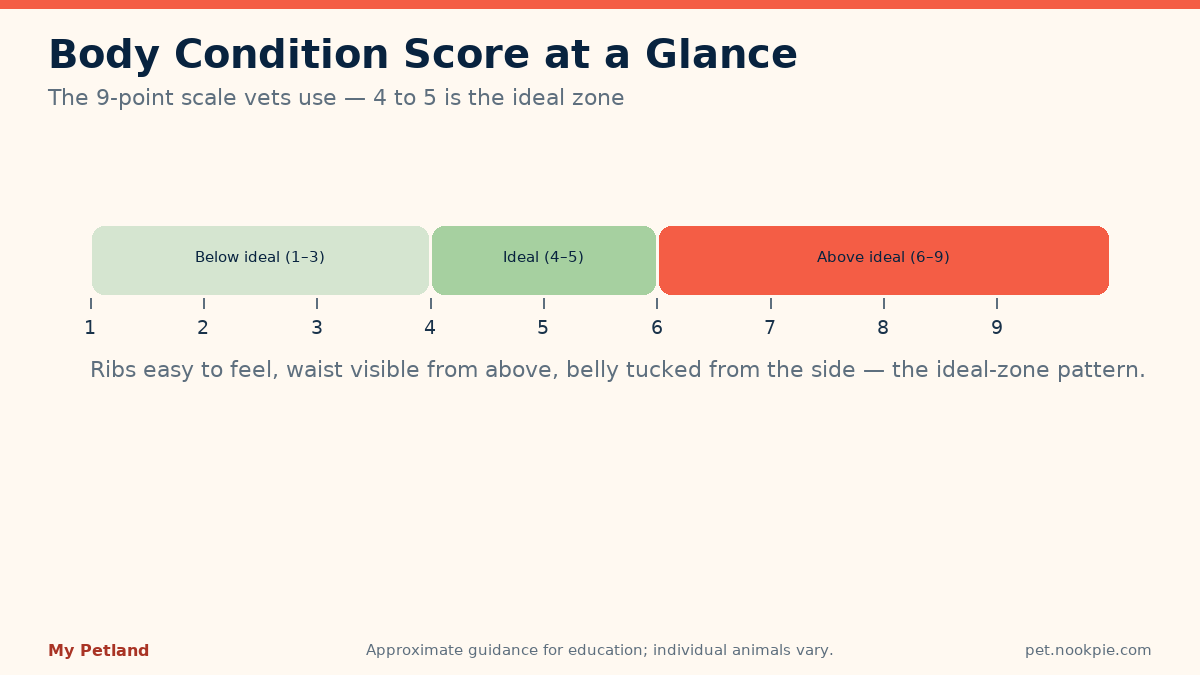
What the ideal range actually feels like
Run your hands over the ribcage with light pressure. At an ideal score, ribs feel like the backs of your knuckles when your hand is flat — distinct under a thin layer of fat. If they feel like your knuckles in a fist, prominent with no padding, the pet is likely under the ideal range. If you have to press to find ribs at all, the pet is likely above it.
Then look from above while your pet stands: an ideal shape shows a waist behind the ribs. From the side, the belly tucks up toward the hind legs rather than hanging level with the chest. These three checks — ribs, waist, tuck — are the whole home assessment.
Some breeds complicate the visual checks: thick coats hide waists, and some sighthounds and lean breeds look “too thin” at a healthy score. When in doubt, trust the rib feel over the silhouette, and ask your veterinary team to show you the technique on your own pet at a routine visit — it is a standard part of a physical exam.
Why body condition matters
The strongest evidence comes from a long-term study of Labrador retrievers published in the Journal of the American Veterinary Medical Association (Kealy and colleagues, 2002): dogs kept lean through portion control lived noticeably longer and developed chronic conditions later than their littermates fed more freely. That is population evidence about keeping dogs lean, not a prescription for how much to feed yours.
Body condition also changes the risk picture around surgery, mobility in older pets, and how well a pet copes with conditions it may already have. It is one of the few things owners directly control.
What a score does and does not tell you
A body condition score is a measurement, not a diagnosis. It does not explain why a pet is gaining or losing, and it does not tell you how much food to serve. Unplanned weight loss, weight gain despite unchanged feeding, or a score that shifts over a few months all deserve a veterinary conversation — they can be the first sign of a medical issue, especially in senior dogs and senior cats.
Likewise, changing a score is a plan, not an event. Safe changes are gradual, and the right rate depends on the individual pet. If your pet’s score is outside the ideal range, bring your hands-on observations to your veterinary team rather than improvising a diet — rapid or unsupervised restriction can be harmful, and some conditions make appetite and weight move for reasons food alone cannot fix.
Scoring your pet at home
Do the three checks monthly, at the same point in the day. Write the score down. A stable record beats a memory, and a slow drift over six months is exactly what owners miss without one. If you keep a care log already, the body condition score belongs next to appetite and water intake — the guides on how much dogs should drink and how much cats should drink cover two other daily numbers worth tracking the same way.
Common questions
Should I use the 9-point or the 5-point scale? Both describe the same three zones. The 9-point scale is the most widely used in companion-animal practice and gives finer resolution, which is why this guide uses it. If your veterinarian’s chart shows a 5-point scale, a 3 out of 5 matches the 4–5 out of 9 ideal zone.
My pet is fluffy. How do I judge the waist? You mostly don’t — coat defeats visual checks. Use the rib feel as your primary check, and wet the coat at bath time if you want a fair look at the silhouette. Grooming appointments are a good moment to re-score.
How fast should an overweight pet return to ideal? Slowly and under veterinary guidance. There is no safe universal timeline — the right rate depends on species, starting condition, and health status, and crash restriction is dangerous, particularly in cats. Bring the score and your feeding routine to your veterinary team and set the plan together.