There is no single birthday that makes a dog senior. Veterinary guidance defines the senior stage as roughly the last quarter of a dog’s expected lifespan — which means the threshold arrives earlier for large and giant dogs and later for small ones. The label is a care signal, not a diagnosis: it marks when closer observation and more frequent veterinary conversations become worthwhile.
The thresholds by size
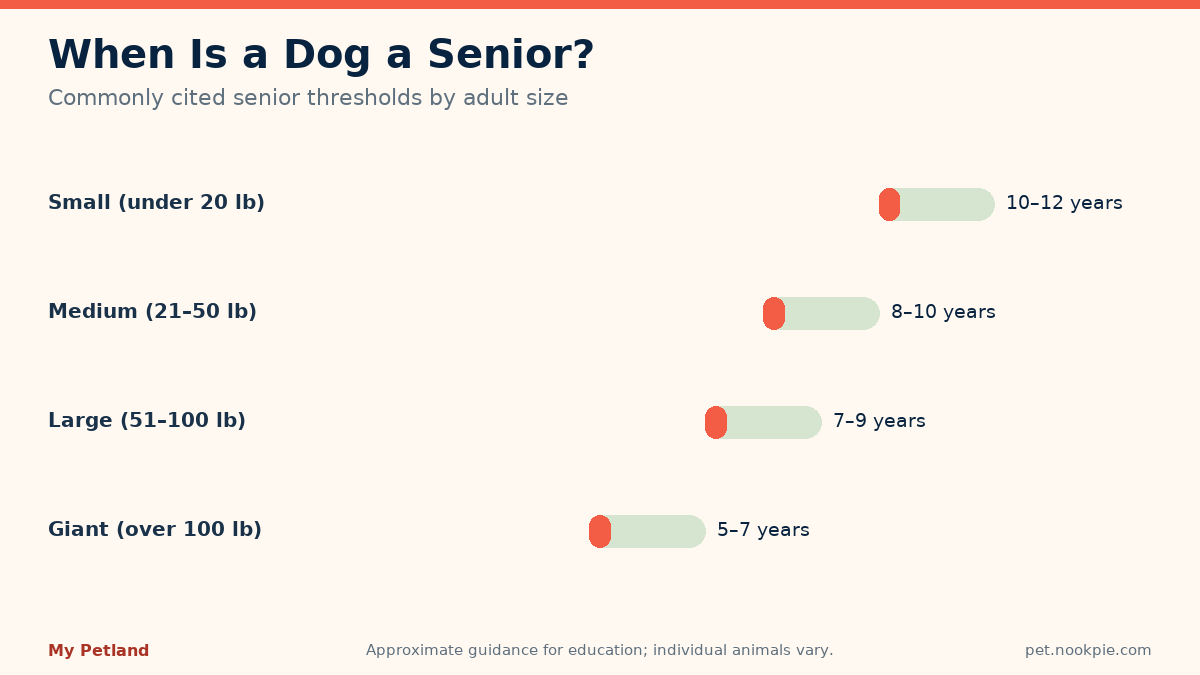
The ranges below are typical approximations drawn from veterinary life-stage guidance. Individual variation is wide, and a veterinarian may place a particular dog’s transition earlier or later.
| Adult size | Typical weight | Commonly considered senior around |
|---|---|---|
| Small | under 20 lb | 10–12 years |
| Medium | 21–50 lb | 8–10 years |
| Large | 51–100 lb | 7–9 years |
| Giant | over 100 lb | 5–7 years |
The reason the thresholds differ is the same reason lifespans differ: larger dogs move through their life stages faster. Our dog years by size chart shows how the human-age comparison diverges, and the dog life stages overview maps the full progression from puppyhood onward.
The gray zone between adult and senior
Between “adult” and “senior” sits a mature-adult stage that is easy to overlook. A dog in this band is typically healthy and active but no longer young — metabolism slows, weight creeps more easily, and the first subtle changes may appear.
Treating this as a transition period is more useful than waiting for a label. It is a good time to establish a clear baseline of weight, appetite, water intake, movement, sleep, and behavior, so that later change is easy to recognize. The adult dog preventive care checklist covers what to track.
What actually changes in the senior years
Veterinary senior-care guidance emphasizes a few practical shifts once a dog enters the senior stage:
- More frequent checkups. Twice-yearly veterinary visits are commonly recommended for senior dogs, because changes can develop faster.
- Closer day-to-day observation. Weight, mobility, appetite, water intake, dental comfort, and behavior deserve regular, calm attention. The senior dog daily care checklist provides a routine.
- Adjusted expectations, not lowered ones. Many senior dogs remain active and content. The stage invites earlier attention to change, not resignation to decline.
What senior does not mean
Age is not an explanation for symptoms. Weight loss, increased thirst, new stiffness, altered sleep, house-training changes, or reduced interest in activity are not “just old age” — they are findings worth describing to a veterinarian. Attributing a new sign to age without an examination can delay care that would have helped.
Equally, the senior label does not predict how much time a dog has. Dogs in the senior stage may live for years in good comfort, and the population averages behind the thresholds cannot forecast any individual.
If you notice a new or progressing sign at any age, our guide on signs your pet needs a vet explains which changes warrant routine, prompt, or emergency attention.
Not sure which stage your dog is in? The calculator shows the current life stage alongside the human-age comparison.
Common questions
Is a seven-year-old dog a senior? It depends on adult size. A seven-year-old giant-breed dog is typically well into the senior stage, a large dog is approaching or at the threshold, and a small dog is usually still a mature adult. Size-specific thresholds matter more than any single birthday.
Does “senior” mean my dog is sick? No. The senior label is a care signal, not a diagnosis. It marks the stage when more frequent checkups and closer daily observation become worthwhile. Many senior dogs remain active and comfortable for years.
How often should a senior dog see a veterinarian? Twice-yearly visits are commonly recommended for senior dogs, because changes can develop faster and earlier attention is simpler. Your veterinary team may suggest a different rhythm for an individual dog’s situation.