A puppy’s first year compresses an entire childhood into months. Development moves so fast that a yearly age chart is too coarse to be useful — this monthly view tracks the transitions owners actually notice. Every puppy is an individual, and breed and expected adult size shift the timing; treat each window as approximate.
The first year, month by month
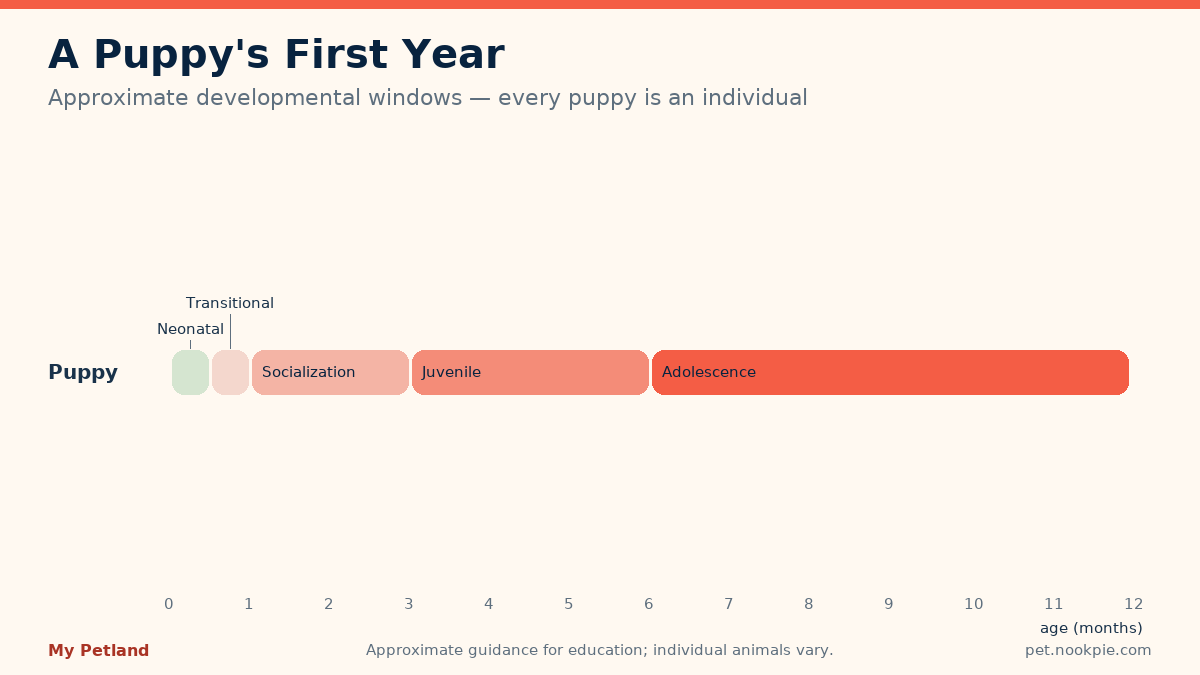
| Age | Stage | What is typically happening |
|---|---|---|
| 0–2 weeks | Neonatal | Eyes and ears closed; fully dependent on the mother; mostly sleeping and nursing |
| 2–4 weeks | Transitional | Eyes and ears open; first wobbly steps; baby teeth begin erupting; early social contact with littermates |
| 1–2 months | Early socialization | Rapid learning from mother and littermates; weaning begins; most puppies go to new homes near the end of this window |
| 2–3 months | Peak socialization | The most sensitive period for positive exposure to people, sounds, surfaces, and handling; first veterinary visits and vaccine series begin |
| 3–4 months | Juvenile | Confidence grows; baby teeth are in; house training progresses; chewing intensifies |
| 4–6 months | Teething and testing | Adult teeth replace baby teeth; energy peaks; some puppies briefly “forget” training as independence emerges |
| 6–9 months | Adolescence | Sexual maturity approaches; size-dependent growth continues; behavior can become more willful |
| 9–12 months | Approaching adult | Small breeds near full size; larger breeds keep filling out; most dogs transition toward adult patterns around the first birthday |
Why the socialization window matters most
Veterinary behavior guidance emphasizes the weeks from roughly three to fourteen weeks as the period when positive experiences shape a dog’s lifelong comfort with the world. The goal is not maximum exposure but positive exposure: brief, calm encounters the puppy can walk away from.
This window overlaps with the early vaccine series, which worries many owners. Behavior and veterinary guidance generally advise balancing disease protection with safe socialization rather than isolating a puppy completely — ask your veterinary team which environments and puppy classes are appropriate given local risk and your puppy’s vaccine status. An online chart cannot make that call.
Size changes the calendar
The stages above describe development, but physical maturity follows size. Small breeds may reach adult height by nine or ten months, while giant breeds continue growing well past their first birthday. Skeletal maturity and behavioral maturity are also different things — a physically large six-month-old is still an adolescent.
This is why the dog age calculator asks about adult size: the same calendar age maps to different life stages depending on how big the dog will become. The dog life stages overview shows where puppyhood ends for each size band.
What to watch at any month
Milestones describe groups; your puppy’s baseline describes your puppy. Consistent daily observation — eating, drinking, toilet habits, play, sleep, movement, and behavior — makes deviations easy to spot. The puppy daily care checklist provides the routine.
Contact a veterinarian promptly for a puppy that stops eating, has repeated vomiting or diarrhea, seems unusually quiet or weak, or shows any new sign that worries you — young puppies have fewer reserves than adults, and “waiting it out” carries more risk. Seek emergency care for breathing difficulty, collapse, repeated seizures, suspected toxin exposure, or inability to urinate.