The American Veterinary Medical Association opens its guidance on choosing a pet with an uncomfortable fact: the primary reason dogs and cats are surrendered to shelters is unfulfilled expectations. Not illness, not cost — expectations. The animal was fine; the match was wrong.
That makes the weeks before adoption the highest-leverage moment of pet ownership. None of the questions below is complicated. All of them are easier to answer now than after a dog or cat is sleeping in your hallway.
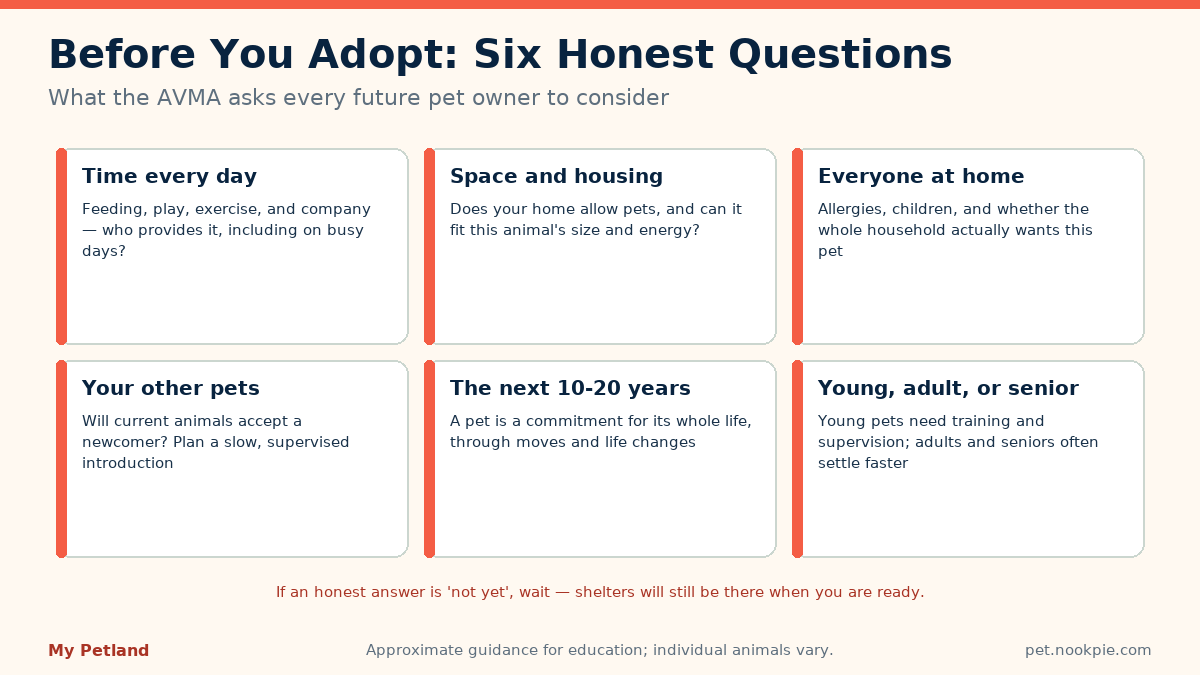
Time: who provides the day?
Feeding, exercise, play, training, and plain company happen every single day, including busy days, sick days, and holidays. The AVMA’s first lifestyle questions are all about time: how long is your workday, what fills your evenings, and who steps in when you are away? A dog isolated in a yard or a room all day is not being kept — it is being stored, and behavior problems reliably follow.
Write down who does what, on an ordinary Tuesday. If the honest roster is “no one, most days,” that is the answer.
Housing and space
Check the rules before the wishes: does your lease or building allow pets, and are there size or number limits? Then the animal’s reality — a large, high-energy dog in a small apartment is a daily negotiation; a cat can adapt to almost any home if its environmental needs are met. Dogs need outdoor access several times a day; think through where that happens in rain, winter, and your schedule.
The whole household
A pet joins everyone who lives with you, not just you. Are all household members genuinely on board? Any allergies to test before, not after? Children can share in care, but the AVMA is blunt that an adult must ultimately own the responsibility — “the kid promised” is not a care plan.
The animals already there
Existing pets get a vote you must count for them. Some older pets tolerate a puppy’s chaos poorly; some cats never fully accept a second cat. Shelter and rescue staff know their animals and can often tell you which ones have lived with other pets — ask, and plan a slow, supervised introduction rather than a first-day meeting in the living room.
The years, not the weeks
A dog or cat is a commitment measured in decades. Dogs commonly live ten to sixteen years depending on size, and cats often longer — an indoor cat reaching fifteen to twenty is unremarkable. The useful test is not “do I want a pet now” but “can I picture caring for this animal through my next move, my next job change, and its slow senior years?” If you can, you are ready. If the picture has gaps, name them before deciding.
Young, adult, or senior
Age is the biggest self-selection you make. Puppies and kittens need housetraining or litter training, socialization during narrow developmental windows, more frequent feeding, and constant supervision — the puppy and kitten guides show how dense the first year is. Adults usually arrive trained and settle faster. Seniors are often the gentlest landing of all, trading more routine veterinary attention for calm.
The AVMA’s age guidance is also a minimum standard: puppies should not leave for a new home before eight to ten weeks, kittens before seven to nine weeks.
Once you have decided
Two steps remain, and both have their own guides. Choosing the individual animal: how to check a pet’s health before adopting covers what to observe at the shelter and what to ask for. And before the pet arrives, prepare the home — food and water stations, sleeping spot, litter box placement for cats, and removing hazards like the everyday foods that are dangerous to pets. Then schedule a veterinary examination within the first days: that first visit is where your pet’s care actually begins.
Common questions
Is it wrong to adopt on impulse if I really love the animal? Love is the easy part — the AVMA notes that unfulfilled expectations are the primary reason pets are surrendered to shelters. An impulse adoption skips exactly the questions that determine whether the next fifteen years go well. If the match is right, it will still be right next week.
Should I get a puppy or kitten, or an adult? Be honest about your time. Young animals need housetraining or litter training, socialization, more frequent feeding, and constant supervision. Adult pets are often already trained and typically settle into a new home faster — and seniors can be the calmest match of all.
What if my situation changes after I adopt? Life changes are exactly what to plan for before adopting: moves, schedule changes, travel, and who cares for the pet in your absence. A pet is a commitment for its whole life — choosing a pet whose needs you can meet even on your worst week, not your best one, is the kindest filter.