Between the young-adult years and the senior stage sits a period veterinary guidelines call the mature adult stage — roughly seven to ten years for cats, and a size-dependent window for dogs. It is the least dramatic life stage and the most strategically important one: the habits and baselines established here shape how the senior years go.
When middle age begins
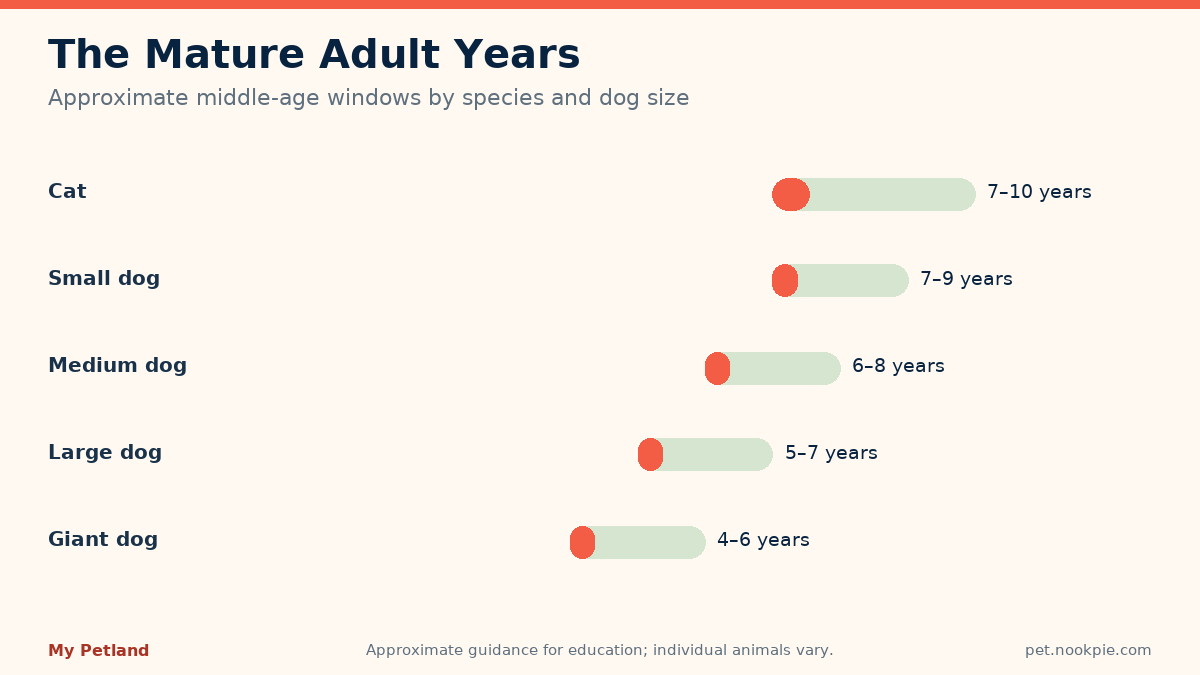
| Animal | Mature adult stage, approximately |
|---|---|
| Cat | 7–10 years |
| Small dog (under 20 lb) | around 7–9 years |
| Medium dog (21–50 lb) | around 6–8 years |
| Large dog (51–100 lb) | around 5–7 years |
| Giant dog (over 100 lb) | around 4–6 years |
These are guideline approximations, not switches. A veterinarian may assess an individual animal as younger or older than the calendar suggests, and the boundaries blend into the stages on either side. The dog and cat life-stage overviews show the full progression.
Why the quiet years matter
Mature adults typically look and act healthy. Nothing announces the stage — and that is exactly the point. Beneath the surface, this is when gradual shifts often begin: metabolism slows, weight creeps up more easily, muscle condition can quietly decline, and early organ changes may start without visible signs.
Three population-level observations make this stage worth attention:
- Weight gained now tends to stay. Excess body condition in middle age is associated with shorter lifespans and earlier problems later. Routine body-condition checks with a veterinarian are more useful than any home scale trend alone.
- Early change is easier to manage than late change. Senior-care guidance emphasizes that many age-associated conditions are first detectable in the mature years, when intervention is simplest.
- Baselines built now pay off later. Knowing your pet’s normal weight, appetite, water intake, movement, and behavior at seven makes a change at eleven obvious instead of debatable.
What mature-adult care actually looks like
Nothing exotic. The stage calls for consistency rather than new products:
- Keep the preventive-care rhythm. Regular veterinary examinations continue; this is a reasonable time to ask what screening, if any, makes sense for your individual pet — not to adopt a universal internet testing calendar.
- Watch the trend, not the day. Monthly notes on weight, appetite, water, movement, and behavior beat daily anxiety.
- Protect the mouth. Dental discomfort accumulates silently; mention chewing changes, breath, and drooling at visits.
- Keep activity appropriate. Mature adults still need movement and play, matched to the individual — neither retired nor pushed like a youngster.
The adult dog and adult cat preventive care checklists cover the daily and weekly routines in detail.
Approaching the threshold
Mature adulthood ends at the senior threshold — around ten for cats, and size-dependent for dogs. Knowing when a dog or when a cat crosses that line helps you anticipate the shift to twice-yearly visits and closer observation, rather than being surprised by it.
One caution worth repeating: new signs are not “just middle age.” Weight loss, increased thirst, new stiffness, or behavior changes deserve a veterinary description at any age. Our guide on signs your pet needs a vet explains which changes warrant routine, prompt, or emergency attention.